
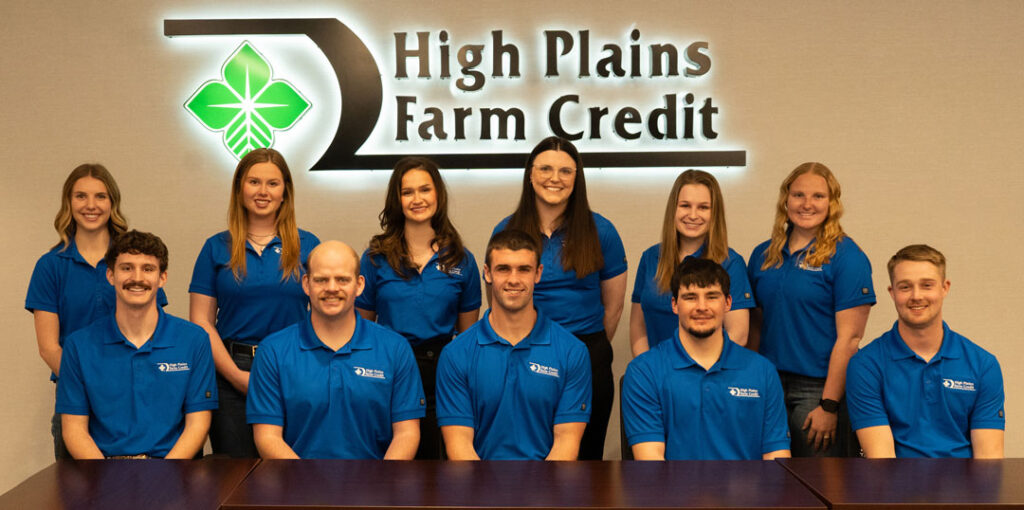
The High Plains Farm Credit Student Board of Directors is a group of Fort Hays State University juniors and seniors who gain exposure to the function of a board of directors while developing decision-making skills related to a financial cooperative.
Each year, the program concludes with the presentation of a research project to the HPFC Board of Directors. This year, the group researched and presented on “Agriculture and Water Availability Issues in Kansas.”
Caring for Kansas Water
Water is essential to agriculture. Without it, our crops cannot grow, farmers and ranchers cannot work, and rural communities struggle. The importance of exercising responsibility in consumption and preservation of this valuable resource is particularly pertinent to Kansans.
This year, the 2024-2025 High Plains Farm Credit Student Board of Directors highlighted two key water sustainability challenges impacting our territory. They explored the effects these issues have upon the agriculture industry, local communities, and our economy.
While the challenges seem vast, individuals and organizations at the local and state levels are working to meet the need for enhanced water sustainability solutions. These adaptations are being implemented with the goal of preserving our water resources for generations to come.
Key Water Availability Issues
Throughout the year, the student board directors focused their research efforts on two main water sustainability challenges impacting farmers, ranchers, and communities in Western, Central, and Southwest Kansas.
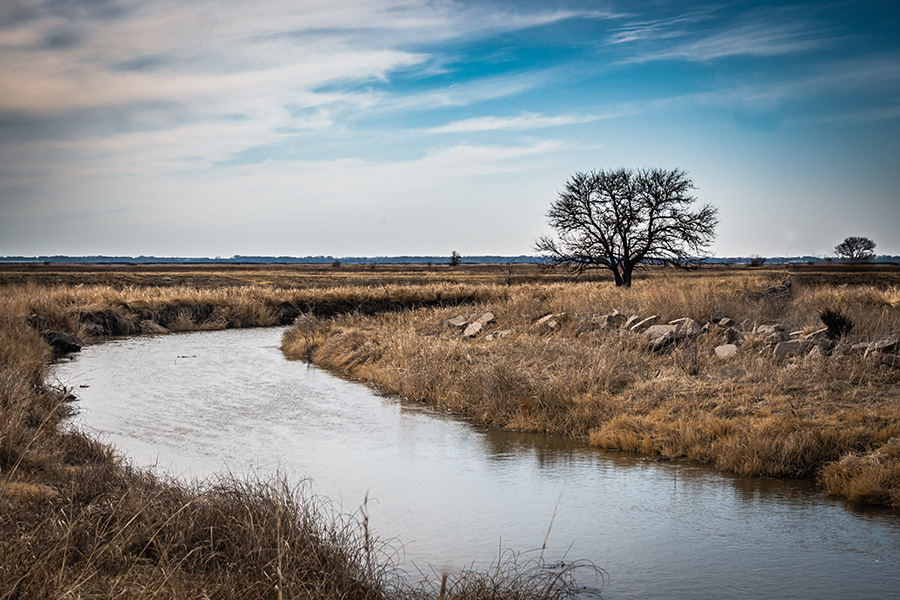
Rattlesnake Creek Watershed
This water source is a surface water system that empties into the Arkansas River and impacts Southwest and Central Kansas. Farmers and ranchers in the area rely on the Rattlesnake Creek as an important source for irrigation in a semi-arid climate.
Discussions and disputes surrounding the water rights and uses are long-standing and the student board explored a timeline dating back to 2013, when the U.S. Fish and Wildlife Service (USFWS) filed an initial claim for impairment.
Ogallala Watershed
The Ogallala Aquifer is one of the largest sources of freshwater in the world. It provides nearly 30% of the groundwater used for irrigation in the United States.
The aquifer spans eight states including Kansas, Colorado, Nebraska, New Mexico, Oklahoma, South Dakota, Texas, and Wyoming. Within our state, the Ogallala is particularly important to Western Kansas.
In fact, it is critical for the irrigation of wheat, corn, and other crops in the arid region. It also supports livestock operations and economic activities in rural communities.
Overuse of this water resource has become a primary concern for farmers and ranchers that utilize the aquifer, as water withdrawals exceeding natural recharge rates have caused levels to drop in key areas.
This issue is becoming particularly pronounced in the part of the aquifer beneath Western Kansas.
Impact of Water Sustainability Challenges on Kansans
Regardless of the water source being discussed, the student board highlighted impacts farmers and ranchers may experience because of water availability issues.
The preservation and responsible use of our water resources is tied closely to the continued success of the ag industry in our state. In turn, this industry is essential to the Kansas economy. In fact, the student board reported that agriculture and agriculture-related sectors contribute a total of $81.2 billion in output and 253,614 jobs in Kansas.
One of the core impacts of water sustainability issues is the potential for economic instability in agriculture-dependent livelihoods. As irrigation costs climb and job losses in farming and related industries increase, rural populations may decline and the ripple effect may impact other pillars of our communities.
Water Conservation Adaptations
The protection of agriculture in Kansas and the responsible use of our water resources must be an effort involving all stakeholders.
The student board underscored the fact that water management ensures that water resources are shared fairly among all users. This includes agriculture, industry, households, and ecosystems.
For those involved in discussions surrounding the Rattlesnake Creek Watershed, this means the cooperation of GMD 5, USFWS, the Kansas Department of Agriculture Division of Water Resources, and many others. As these stakeholders move through the planning phase, they have set goals for the design and implementation stages in 2026 and 2027.
Meanwhile, individuals and groups addressing the depletion of the Ogallala Aquifer in Western Kansas are focusing on new water management policies and water conservation technologies to preserve water supplies for the future.
The five-year management plan includes voluntary water rights buyouts and leasing programs, as well as precision irrigation technologies and soil moisture monitoring systems. Farmers in the area may also transition to drought tolerant crops requiring less irrigation.
Even as these practices are implemented, education surrounding irrigation practices is essential to decreasing the strain on water supplies. As Kansas increases allocations to the State Water Plan Fund and many organizations look to a new farm bill that includes support for the Ogallala, each individual has a role to play in understanding the water sustainability challenges impacting our rural communities today.



 Equal Housing Lender